
Exposure Is Not Risk
Why geopolitical analysis needs to distinguish contact from consequence
Geopolitical risk analysis often treats major features of the international environment as though they are risks in themselves. Multipolarity, China, artificial intelligence, climate change, sanctions, industrial policy, populism, and deglobalisation are all commonly placed in the risk category. These issues clearly matter, but describing them as risks too early can make the analysis less useful. Before something can be understood as a risk, we need to know who is exposed, how they are exposed, what part of the organisation is affected, and what consequence could follow.
A better starting point is exposure. Exposure means contact with an external condition. A company with operations in Taiwan is exposed to cross-Strait tension. A manufacturer that depends on rare earth elements is exposed to Chinese export controls. A food company that depends on Black Sea grain is exposed to the consequences of the war in Ukraine. Those exposures are real, but they do not tell us enough on their own. The important question is what the exposure touches inside the organisation. It may affect revenue, supply, financing, regulation, insurance, reputation, people, data, or strategic choice. It may also reveal a single point of failure, or it may show that the organisation has alternatives, resilience, or room to adapt faster than competitors.
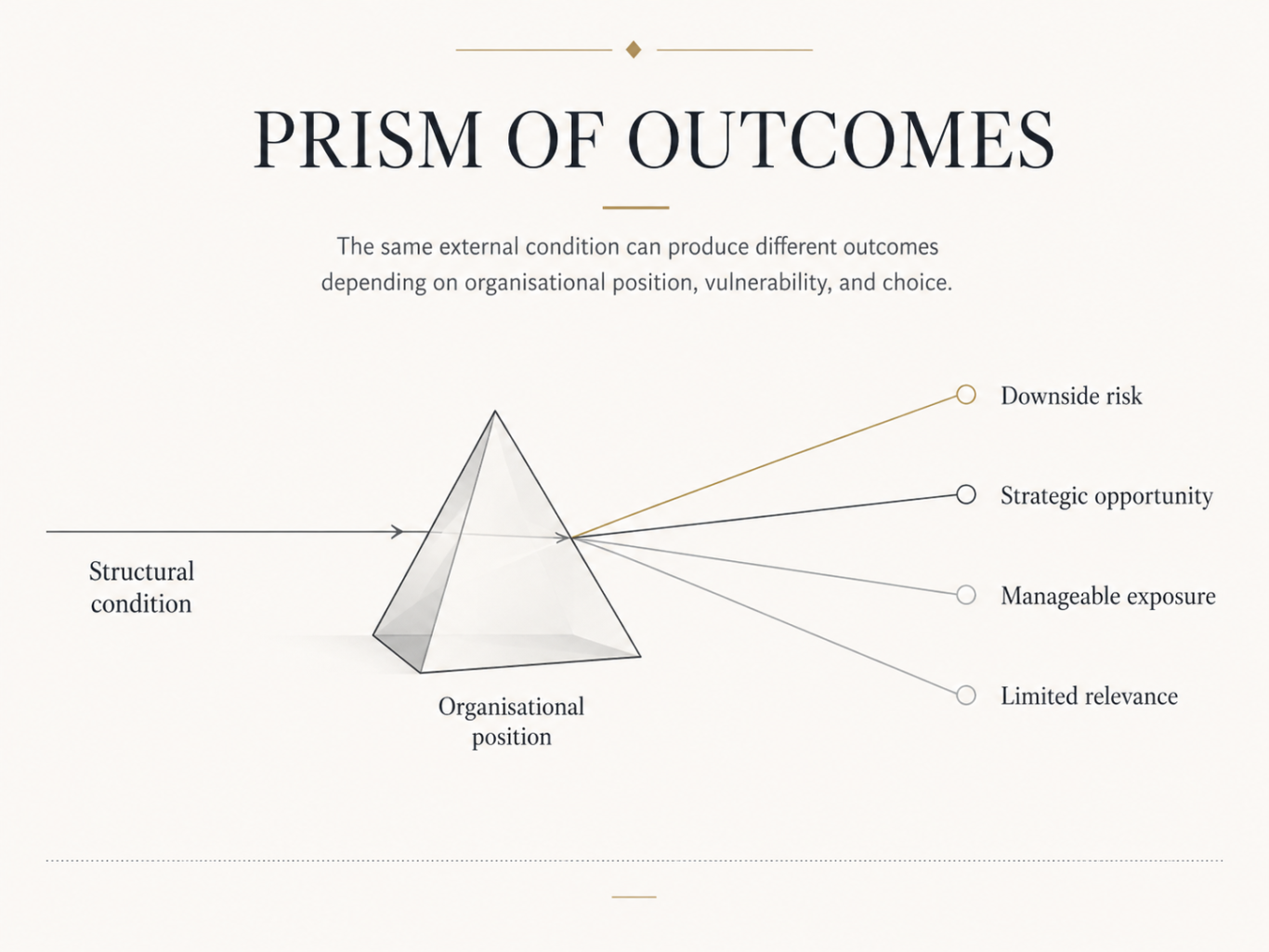
This is why the same geopolitical development can create different outcomes for different organisations. U.S.-China competition has created serious problems for firms dependent on advanced technology exports to China, but it has also increased demand for compliance, cybersecurity, defence production, supply-chain diversification, and alternative manufacturing hubs. Russia’s invasion of Ukraine damaged companies exposed to Russian energy, Black Sea grain, and European security instability, but it also increased demand for liquefied natural gas, defence production, cybersecurity, renewable energy, and energy infrastructure. The event matters, but the event is not the whole analysis. Risk sits in the relationship between the external condition and the organisation’s position.
That distinction matters because vague risk language leads to vague decisions. If a board is told that multipolarity is a risk, the result is likely to be concern without a clear course of action. If the board is shown how multipolarity affects suppliers, customers, regulation, market access, pricing, investment, and competitive position, the conversation becomes more useful. The issue is no longer whether the world is dangerous in general terms. The issue is how a specific organisation is connected to a changing external environment.
The same logic applies to opportunity. Exposure does not only create danger. Industrial policy can create pressure for companies built around older assumptions of global efficiency, but it can also benefit firms positioned for subsidies, domestic manufacturing, defence procurement, and infrastructure investment. Energy transition policy can create problems for fossil-fuel-intensive business models, but it can also create advantage for companies involved in grids, critical minerals, batteries, nuclear power, and carbon management. The point is not to downplay geopolitical risk. Many geopolitical risks are real and serious. The point is to avoid treating the whole environment as a threat.
A more useful assessment starts with the relationship between the external condition and the organisation. It asks what the source of exposure is, which assets or objectives it touches, what the transmission pathway looks like, where vulnerability exists, and what consequence could follow. Only then does it make sense to call something a risk.
For most organisations, geopolitical exposure cannot be eliminated. Companies, investors, universities, governments, and institutions cannot opt out of strategic competition, technological change, economic fragmentation, or political pressure. The task is to understand exposure clearly enough to see where it creates vulnerability, where it creates resilience, where it creates advantage, and where it may not matter very much at all. That is the difference between geopolitical analysis that makes the world sound dangerous and geopolitical analysis that helps people make decisions.